Sure enough, when I arrived at the Upper Pond a few minutes later, at least one of the adults was still in a highly agitated state, slapping and swimming back and forth very energetically. I had things to do before dark so I moved on but just in case the dispersing youngster was considering staying, I avoided Preston Pond when returning. Over the next few days, I documented his work (I say "his" since according to Cree and Innu I've talked to up north, typically, it is the young males who establish a residence and the females look for a male with a good set up) on the dam and noted that he had made castor mounds at points around the pond and there were numerous feeding sites along the west shore where the forage was dense. His dam building skills were pathetic but improved quite quickly. The lake level rose to the point that the old submerged dam was again mostly submerged and Bonnie and I could access the main lake with our canoes, but we avoided the pond a bit not wanting to spook him off. We saw him from time to time though and he was probably used to people from growing up on the Upper Pond which is immediately next to a hiking and VAST trail, so after a couple of weeks, we guardedly celebrated having a beaver back in the lake.
Peak Foliage
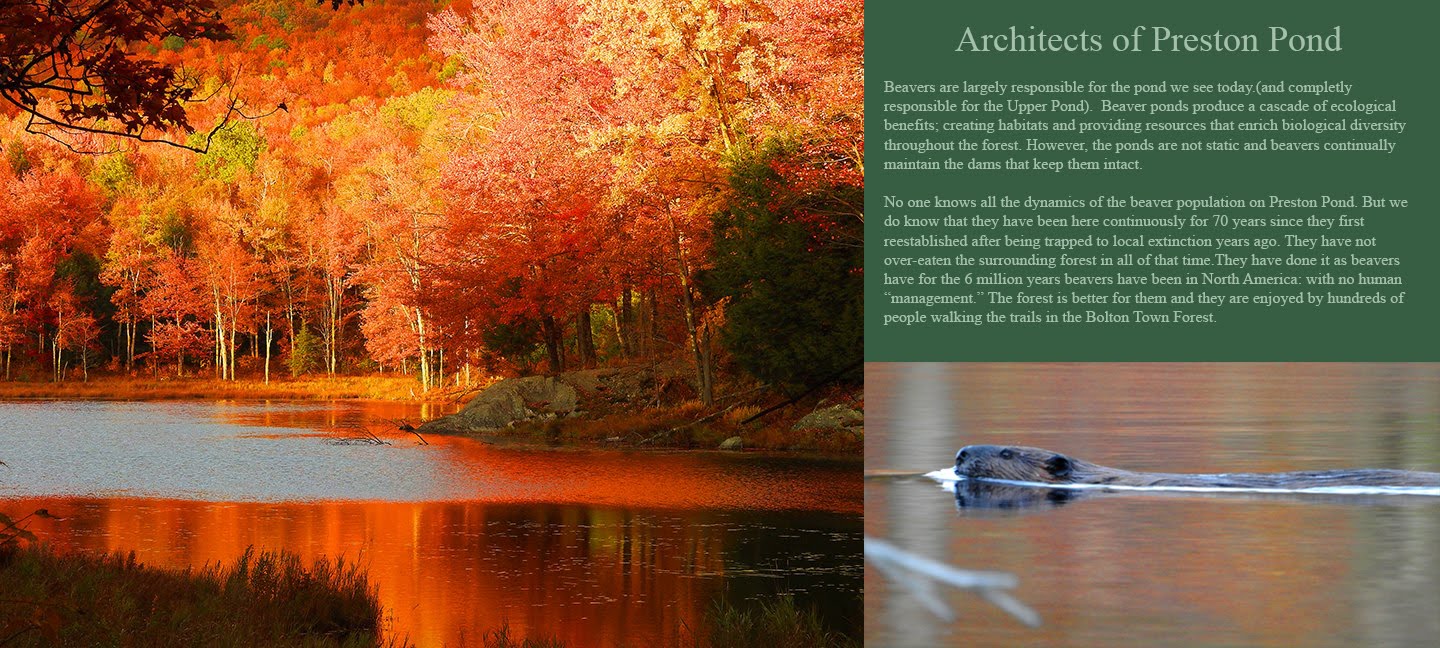
October on Preston Pond
Saturday, July 27, 2019
Leave It To Beaver(s)!
It took three years, one month, two weeks, and five days, but they're back! Dispersing young from the Upper Pond had disappointed us over the last three years by just moving on, but May 15, 2019 was to be different. I was on my way to tend to a trail issue that evening and walking above Preston Pond on the western ridge. The leaves weren't out yet so I had a clear view of the entire lake when motion in the marsh at the north end caught my eye. The binocs revealed a beaver moving down the feeder stream from the Upper Pond in what seemed a near panic. It entered Preston Pond and swam straight and fast as though its life were at stake. Finally, across from the ledges on the east shore, it slowed and submerged. It was odd behavior for a beaver. I guessed I had chanced upon the moment a second-year had been chased from its natal pond - in this case, the Upper Pond, whose colony, unlike Preston Pond's, survived the trapping in 2016.
Sure enough, when I arrived at the Upper Pond a few minutes later, at least one of the adults was still in a highly agitated state, slapping and swimming back and forth very energetically. I had things to do before dark so I moved on but just in case the dispersing youngster was considering staying, I avoided Preston Pond when returning. Over the next few days, I documented his work (I say "his" since according to Cree and Innu I've talked to up north, typically, it is the young males who establish a residence and the females look for a male with a good set up) on the dam and noted that he had made castor mounds at points around the pond and there were numerous feeding sites along the west shore where the forage was dense. His dam building skills were pathetic but improved quite quickly. The lake level rose to the point that the old submerged dam was again mostly submerged and Bonnie and I could access the main lake with our canoes, but we avoided the pond a bit not wanting to spook him off. We saw him from time to time though and he was probably used to people from growing up on the Upper Pond which is immediately next to a hiking and VAST trail, so after a couple of weeks, we guardedly celebrated having a beaver back in the lake.
Then, on or about June 6, his castor mounds worked. A neighbor informed us that he and his wife had seen two beavers on the pond. We took the canoe out that evening. There were no dispersing young adults upstream of Preston Pond other than his sibling so possibly a dispersing female from the pond across the Stage Rd from us caught the scent. We spotted them almost immediately and watched the pair of them canoodling together up at the northern end near the collapsed west shore lodge. We now can again enjoy an evening paddle around the pond. We always see them and while they still give us a slap or two, they seem to becoming used to us. They aren't to the point that the former beavers were (swimming along with the canoe and playing with one of our dogs; those photos and videos are farther back in this blog), but these two have decided, as untold numbers of beavers have in the thousands of years before them, that Preston Pond is the place to live.
Sure enough, when I arrived at the Upper Pond a few minutes later, at least one of the adults was still in a highly agitated state, slapping and swimming back and forth very energetically. I had things to do before dark so I moved on but just in case the dispersing youngster was considering staying, I avoided Preston Pond when returning. Over the next few days, I documented his work (I say "his" since according to Cree and Innu I've talked to up north, typically, it is the young males who establish a residence and the females look for a male with a good set up) on the dam and noted that he had made castor mounds at points around the pond and there were numerous feeding sites along the west shore where the forage was dense. His dam building skills were pathetic but improved quite quickly. The lake level rose to the point that the old submerged dam was again mostly submerged and Bonnie and I could access the main lake with our canoes, but we avoided the pond a bit not wanting to spook him off. We saw him from time to time though and he was probably used to people from growing up on the Upper Pond which is immediately next to a hiking and VAST trail, so after a couple of weeks, we guardedly celebrated having a beaver back in the lake.

Wednesday, July 24, 2019
We're Back: Golden Eagle over Preston Pond (and more to come).
I started this post last October and never posted it. Picking up where I left off:
Well, we have been inactive on this blog since the debacle in which the 2015/2017 Select Board allowed the Preston Pond beaver colony to be exterminated and refused to act to prevent future repetitions of the fiasco.
However, Sunday (October 28, 2018; and the passage of time) gave us a good reason to get back to it. A Golden Eagle over Preston Pond!
I reported a Bald Eagle earlier this year on the pond on Front Porch Forum. It was the first I'd ever seen actually on Preston Pond, however, Bald Eagles are not rare here and actually nest in Missisquoi. Golden Eagles are rare in Vermont. Happily, I've seen many Goldens in travels out west, northern Canada, and Alaska including one just last month while canoeing across the Ungava Peninsula between Hudson and Ungava bays, so I'm easily familiar with distinguishing them from immature Bald Eagles and Turkey Vultures.
This one was soaring over the north end of Preston Pond at 3:00 pm Sunday, October 28. When I first spotted it, it was about 500 ft up and sidling and spiraling down. It was a heavily overcast day and with the low, late afternoon light created very poor lighting conditions for telephoto shots. However, as the bird descended, I picked out some telltale field marks of a Golden; slight V to the wings (less than a vulture but more than the board straight posture of a Bald), slight crook to the wings, primaries spread into fingers, relatively small head and long tail. In my shots, the golden nape showed clearly enough to be determinative. The photo has been confirmed by a host of experts.


Well, we have been inactive on this blog since the debacle in which the 2015/2017 Select Board allowed the Preston Pond beaver colony to be exterminated and refused to act to prevent future repetitions of the fiasco.
However, Sunday (October 28, 2018; and the passage of time) gave us a good reason to get back to it. A Golden Eagle over Preston Pond!
I reported a Bald Eagle earlier this year on the pond on Front Porch Forum. It was the first I'd ever seen actually on Preston Pond, however, Bald Eagles are not rare here and actually nest in Missisquoi. Golden Eagles are rare in Vermont. Happily, I've seen many Goldens in travels out west, northern Canada, and Alaska including one just last month while canoeing across the Ungava Peninsula between Hudson and Ungava bays, so I'm easily familiar with distinguishing them from immature Bald Eagles and Turkey Vultures.
This one was soaring over the north end of Preston Pond at 3:00 pm Sunday, October 28. When I first spotted it, it was about 500 ft up and sidling and spiraling down. It was a heavily overcast day and with the low, late afternoon light created very poor lighting conditions for telephoto shots. However, as the bird descended, I picked out some telltale field marks of a Golden; slight V to the wings (less than a vulture but more than the board straight posture of a Bald), slight crook to the wings, primaries spread into fingers, relatively small head and long tail. In my shots, the golden nape showed clearly enough to be determinative. The photo has been confirmed by a host of experts.


Friday, September 29, 2017

Wednesday, September 27, 2017

con·ser·va·tion ˌkänsərˈvāSH(ə)n/ noun
- the action of conserving something, in particular.
- preservation, protection, or restoration of the natural environment, natural ecosystems, vegetation, and wildlife.
- the act of conserving; prevention of injury, decay, waste, or loss
Situation
· Select Board (SB) approved first documented beaver trapping on Preston Pond*. 12/14/15:
· Traps in Preston Pond February 9 – February 12, 2016*2
· Preston Pond beaver colony exterminated. *3
· Bolton Conservation Commission (CC) added a restriction on unnecessary (sport) trapping to the draft PPCA (Town Forest) Management Plan by a 5:1 vote*4 May, 2016
· SB removes CC’s recreational trapping restriction and rewrites to allow all trapping pending SB permission. SB wiil voting to approve amended plan, Tuesday, October 3, 2017
What you can do:
· Write the Select Board prior to Tues evening October 3.
· Alert your neighbors, especially those who live near and/or use the PPCA
Whether you support trapping in general or not, if you can agree that putting family pets at risk with traps along popular hiking trails or risking our last small beaver colony is ill-advised, support the Bolton Conservation Commission’s management plan trapping provisions:
Contact the Select Board through Town Clerk Amy Grover: clerkbolton@gmavt.net to send written statement. For more information or questions, reply to this email or contact Rob Mullen: rob@robmullen.com
Background
- The CC plan allowed trapping in the PPCA only for management/safety. No effect elsewhere.
- The PPCA is 403 acres. Bolton has 29,800 acres, most freely available to trappers.
- The 403-acre PPCA is undoubtedly the most frequented natural public space in Bolton, if not Chittenden County; the trails around Preston Pond and Libbys Lookout are some of the most popular day hikes in Vermont.
- The Select Board is reserving the power to allow:
- Leghold and killing traps*5 30 yards from trails.
- Drowning trap sets in the ponds for the remaining Upper Pond beavers and any otters, mink, etc.
- Bolton has 1,200 residents and two (2) licensed trappers (Fish & Wildlife Dept.)
- There is no history/tradition of trapping in the PPCA. Historic use has been cited as a reason to allow trapping in the PPCA. Beavers were exterminated in VT by the fur trade even before Ethan and Ira Allen arrived. Reintroduced in the 1920’s and ‘30’s, recolonizing beavers arrived at Preston Pond in 1946. The PPCA property was wholly owned by Jerry R. Mullen from 1946 to 1989. There was no trapping. From 1990 to 2003, a developer owned it and while he reports giving verbal permission to one Bolton resident to trap, the VT Fish & Wildlife Department reports that there were no licensed trappers in Bolton at that time and it is not known if any trapping occurred. From the time the property was acquired by the town of Bolton in 2003, to the first trapping application in November 2015, there was no trapping in the PPCA. The trapper in 2016, may have been the first person to set beaver traps in Preston Pond since the 1700’s; certainly, the first legal ones.
- Whatever one thinks of trapping, it is a legal pursuit and where it poses no realistic hazard or impact on other residents, it is the SB’s right to leave it be. However, there is good reason to believe (and evidence in the shrinking Preston Pond – unmaintained, the main dam is a sieve and the lower part of Preston Pond, a mud puddle), it is not appropriate within the relatively small and well-used PPCA (which we may have to rename the Preston Puddle Conservation Area).
* At the 12/14/15 SB meeting, despite touting trapping as an excellent “wildlife management tool,” when asked, the SB acknowledged that there was no wildlife management problem. The SB promised trapping would be “sustainable” but when asked, admitted to having no idea of colony populations in either pond. When it was pointed out that there were few beavers in Preston Pond and that the colony was vulnerable, the information was ignored.
*2 Trapping on Upper Pond – separate colony- Feb.9-Feb. 15. Only one juvenile killed. Colony weak but still there.
*3 First absence of beavers in Preston Pond in at least 30 years. Colony established in 1946 with only one or two short absences since then. Beavers in constant residence since mid-1980’s.
*4 The night of the vote, one CC member was absent and supported the measure by letter so the vote of members present was 4-1 but support of the restriction was 5-1. The one opposed was (and is) a full-time professional lobbyist in Montpelier for, among other things, trapping.
*5 If you are familiar with leghold traps, a captured dog can be released fairly easily if you aren’t bitten by a panicked animal. Injuries are usually minor, (for the dog), if released soon, though substantial veterinarian bills are possible. However, the bottom line is that your pet will very likely survive – if you are present.
Not so likely with Conibear body-gripping kill traps. Few if any trappers are likely use such traps near trails, but we have had conflicting comments on this issue. The fact that the SB insists on keeping such an option open is all by itself reason to trust the CC on this issue.
Friday, September 23, 2016
Bolton Wildlife wins national award (small one)

This piece was submitted to Southwest Art Magazine's 2016 Artistic Excellence Competition just before I left for James Bay. I had less than two days to do it, so it wasn't completely finished (still some refining in foreground) and is not signed yet. It was an open international contest with no separate categories (which means wildlife has to go up against figurative, landscape, still lives etc) so I wasn't expecting much. And true enough I didn't make the cut for the big awards but was notified yesterday that it is in the "Top 100 Honorable Mentions" out of over 1,500 paintings. Minor award and small news in an art career but kind of fun that it is my first painting from Bolton that has won something on a national level.
Sunday, September 18, 2016
I'm BAAAACK! Been canoeing in the North.
Well, almost 3 months quiet. That ends now, though this one post will be a bit off topic.
15 years ago, I guess I had a mid-life crisis (one of a few possibly). I was 45 and feeling drained by the stress of the national art show circuit. I was a wildlife artist but spent most of my time in the studio or driving thousands of miles across the country to shows at which we'd spend days on end standing and talking about the inspiration of our art (and hopefully selling some). The irony was that I had no time for one of the main inspirations of my art: wilderness: real wilderness, not touring Yellowstone and various National Wildlife Refuges by car.
So I blew off my schedule and planned a 330-mile "Source to Salt" canoe journey on the Missinaibi River to James Bay: southernmost point of the Arctic Ocean. Almost made it too.

"Conjuring House Rock" Thunderhouse Gorge, Missinaibi River 16" x 28" acrylic - Mullen
18 days into the trip a four-day storm crescendoed with a full gale with blinding sheets of rain, screaming 40 mph + winds that shifted suddenly from northerly to WSW and temps in the low 40's. It hit around 5:00 am September 9 and nearly tore my camp apart (I had set up hurriedly in the bush with the north wind). Happily, I have always tied my knots "on the bight" and so was able to quickly reset the storm tarp that provided a windbreak for my light tent. In the afternoon, the wind had subsided enough to allow me to safely get on the water and I went downstream looking for a more secure campsite. I found a beauty under an enormous red spruce on an island. I set my tarps up and snugged my tent under them and managed to build a fire (no camp stove back then). As night rolled in, I thought I caught a glimmer of light above the trees to the west. The sun? I could only hope.
The dawn was a glory. There is little that can compare with being alone on a wilderness river and having endured days of cold, wind, and rain and to then wake up to a stunning sunrise. It could only be better by running to the shore with your camera and nearly colliding with three Sandhill Cranes. It was a religious experience. I did a field sketch and resolved to do a large painting back in the studio. I paddled 30 exhilarating miles, including Deception Rapid, set camp on Portage Island, and painted the last of the Missinaibi while dinner cooked and I fed peanuts to the Gray Jays who sat on my hat.

Field study from Portage Island: 6" x 12" acrylic.
The field painting was the basis of "River's End" 18" x 24" acrylic (done much later).

It was two days later that I found out what the dawn of September 11, 2001, was back home. I was at the Cree Indian village of Moose River Crossing where the Ontario Northland RR crossed after coming up along the Abitibi River to the SE and flagged down the next train. I was 40 miles from the Arctic Ocean. It took 18 months to start River's End and "First Light" 24" x 36" acrylic below.
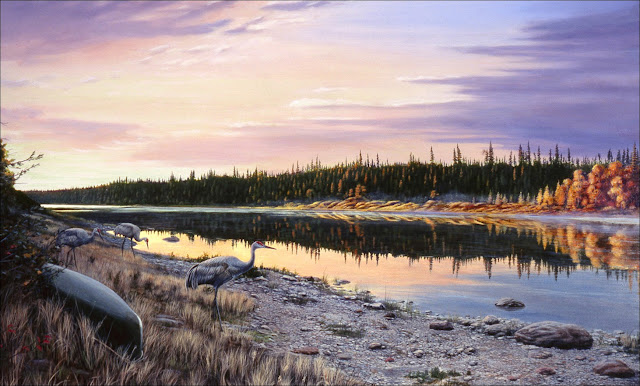
I ran 15 more wilderness expeditions after that; from Labrador to Alaska but never went back to the Missinaibi. Then a string of situations concurred this year to inspire a return. And we are back (I had a crew of four this time) and we made it to the sea. The end of our canoe journey was a classic. In a scene that could have been 150 years earlier, we ground onto the beach just below the original Hudson Bay Staff House at Moose Factory; now run by the Moose Cree First Nation as a Historical Site. We stayed at the Staff House (reputedly complete with ghosts) and were treated to a traditional Bannock and Tea reception accompanied by the High Ridge Singers; a traditional Cree drumming and singing group - all young men.
Sunday, June 19, 2016
Mesozoic Soundscape
It is fascinating to note the changing frog choruses through spring into summer. The Peepers are still at it, but not at the near deafening level they were in May. The bullfrogs are going loud and long now at various times, but their schedule is capricious (still need a confirmation recording or photos of them if anyone is that ambitious). However, an interesting shift in the higher forest ponds of late has been the change to Gray Tree Frogs. They've been an accent to the overwhelming Peeper chorus for many weeks now. However, when Bonnie and I were coming back from a walk through the abandoned beaver ponds in the saddle south of the Pinnacle (Bolton Cliffs to some), they became the only voices as we left the ponds behind and the pass narrowed, providing an eerie and evocative accompaniment as we headed home for dinner.
Friday, June 17, 2016
Looking for a Bear: Found Two Paintings (will look for the bear later)
As a wildlife artist, I tend to be a rather opportunistic hunter. Most often I just go out to see what I'll see, but even if I have deer in mind when I head out, if a flock of turkeys wanders by, I am happy to switch. After filming the Black Bear last week, I went out to see if he had a regular route or had just been wandering through (bears can be very habitual). I found his trail easily enough, but it is not heavily used. Even so, I decided to sit down for a while and see if anyone happened by.
Speaking of looking for bears, here are a couple shots from expeditions in Nunavik (far northern Quebec) and Labrador where we have found the bears to be very curious/tolerant of people - most likely because they have rarely if ever seen any.


Top photo by Gary McGuffin on our 2006 WREAF expedition on Mushua-shipu (George River) to Ungava Bay. I had some shots here, but Gary was our pro, so we gave him front row (we were all in canoes).
Bottom photo by Cole Johnson on our 2009 WREAF "Trans-Labrador Expedition" (I was holding the canoe steady).
I stayed still and quiet for over an hour. In that time I saw no large mammals, but the local bird life apparently decided I had become a part of the scenery. Hairy Woodpeckers had a nest in front of me and were busy feeding their noisy brood.
There will be a painting out of this eventually. The nest tree has interesting color patterns and lichen and the birds have to exit the nest with a bit of a curve that could work with a composition, but they weren't first in line after all was said and done.
The hen Wood Duck zoomed past a couple times and a pair of Flickers were having a grand time. They kept at it just behind me, but being backlit I didn't bother trying to photograph them. Then, seeming to realize that if they wanted to be painted they would have to step up their game and give me some better light, they moved to a different tree more to my side. They were right: the light was good. Moreover, they struck and held various poses. They obviously wanted to be painted. I rarely snub such eager subjects. Not quite done yet, but "Forest Flickers" Bolton Town Forest 12" x 9" acrylic is below. Still some refinements to do, but on to other things for a while. I like to put paintings up for a bit when at this stage before finishing them off; gives me time to recognize at least some of the errors I've made.


Speaking of looking for bears, here are a couple shots from expeditions in Nunavik (far northern Quebec) and Labrador where we have found the bears to be very curious/tolerant of people - most likely because they have rarely if ever seen any.


Top photo by Gary McGuffin on our 2006 WREAF expedition on Mushua-shipu (George River) to Ungava Bay. I had some shots here, but Gary was our pro, so we gave him front row (we were all in canoes).
Bottom photo by Cole Johnson on our 2009 WREAF "Trans-Labrador Expedition" (I was holding the canoe steady).
Sunday, June 12, 2016


Thursday, June 9, 2016
Revised art work and more coming

9" x 12" acrylic
This painting was posted a couple months ago, but I didn't like the bird's wing position and some other naggy stuff so I repainted it. Two paintings starting this week from yesterday's foray and of course I'll be working on something with the bear. Hopefully some better reference on him soon.
Tuesday, June 7, 2016
Looking for a Water Bottle : Found a Bear
I was helping guide a class of fourth graders from Jericho Elementary around Preston Pond and Libbys Lookout Monday. As we headed into the Town Forest I told them to keep their eyes peeled because a large bear had been seen in the area. No luck spotting it of course (21 people walking through the woods: not quiet). However, one of the students asked if afterwards I could look for his water bottle that he thought he'd dropped along the way. So yesterday afternoon I headed out with the dogs to backtrack the route. Got to our first stop where he thought he'd most likely dropped it. No water bottle, but scanning for the Wood Duck family I spotted this fellow - right where we'd been the day before. What a treat for the kids this would have been. Sending the class the video as a second-best: they were close.
Interestingly, the dogs never saw it (I have a height advantage) and the bear showed no sign of knowing we were there either. The water bottle turned out to be on the bus, but had he not mistakenly thought he'd dropped it, I wouldn't have run into the bear.
Wednesday, June 1, 2016
Frog songs and Deer snorts

The local deer weren't happy that I was out and about when normal humans are at home with loved ones. I jumped two at very close range walking out at dusk (8:50 pm) and around 10:00 pm, while focused on recording frogs along the west shore of Preston Pond, a deer came up on me from behind along the same beaver trail I had used and scared itself. It belted out a series of warning snorts. Bit of a start for me too:-).
Saturday, May 28, 2016
Memorial Day Weekend Parade on Preston Pond

Wednesday, May 25, 2016
May Chorus Upper Pond
This has always been one of the most captivating sounds to me: music dinosaurs listened to (well, not the owls, but the frogs). One of these days I will have to be hard-hearted and not bring the dogs along when I want to record frogs. They were pretty good really.
Been much going on and have been very inattentive to this blog. Have not been inattentive to the pond though. We have been at least out to and often around the pond every single day. Still no beavers on the main pond. There are at least one or two on the Upper Pond.
A Great Blue Heron has been hanging around a lot lately and the otters were back a few days ago. Brief visit. Haven't seen them since. The Barred Owls are finally making a bit of a racket. They have been unusually quiet much of this spring so far. The frogs are in full chorus though. A few nights before this video was recorded, Bonnie and I went up and Bonnie had to turn back. She had a headache and the intensity of the frog song was too much.
Been much going on and have been very inattentive to this blog. Have not been inattentive to the pond though. We have been at least out to and often around the pond every single day. Still no beavers on the main pond. There are at least one or two on the Upper Pond.
A Great Blue Heron has been hanging around a lot lately and the otters were back a few days ago. Brief visit. Haven't seen them since. The Barred Owls are finally making a bit of a racket. They have been unusually quiet much of this spring so far. The frogs are in full chorus though. A few nights before this video was recorded, Bonnie and I went up and Bonnie had to turn back. She had a headache and the intensity of the frog song was too much.
Tuesday, April 26, 2016

Aside from Algonquin Park in Ontario, Canada, this was the first otter I had seen in Vermont. 3 of them hung around for days as the ice was melting, giving them a place to sample their catches of the day.
Bonnie

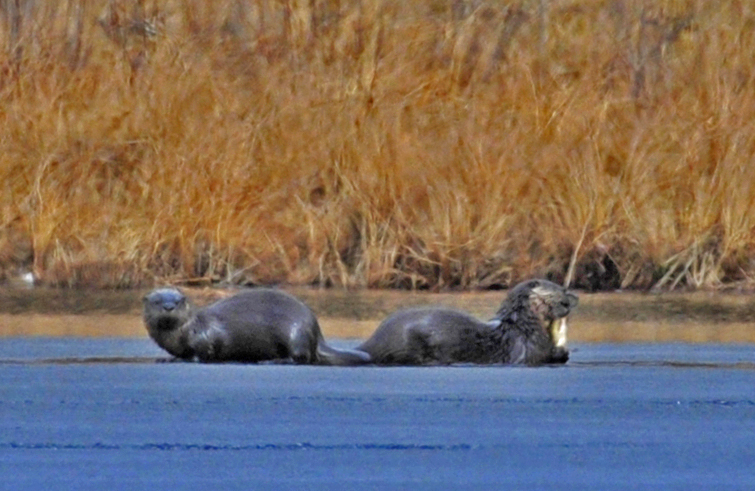
Bookends

Friday, April 22, 2016
Osprey and Otters
Well, I have gotten rather behind and will stay behind a bit, but for Earth Day I think it worth noting that on April 19 we had a pretty good day on the pond. Not the happiest days around here lately. The one beaver we had seen in late March and another (possibly the same) on April 13, has disappeared again. It may have gone looking for company to the Upper Pond, but whatever or wherever, there are none to be seen here now for the first time in my lifetime. Still, Tuesday was a good day.
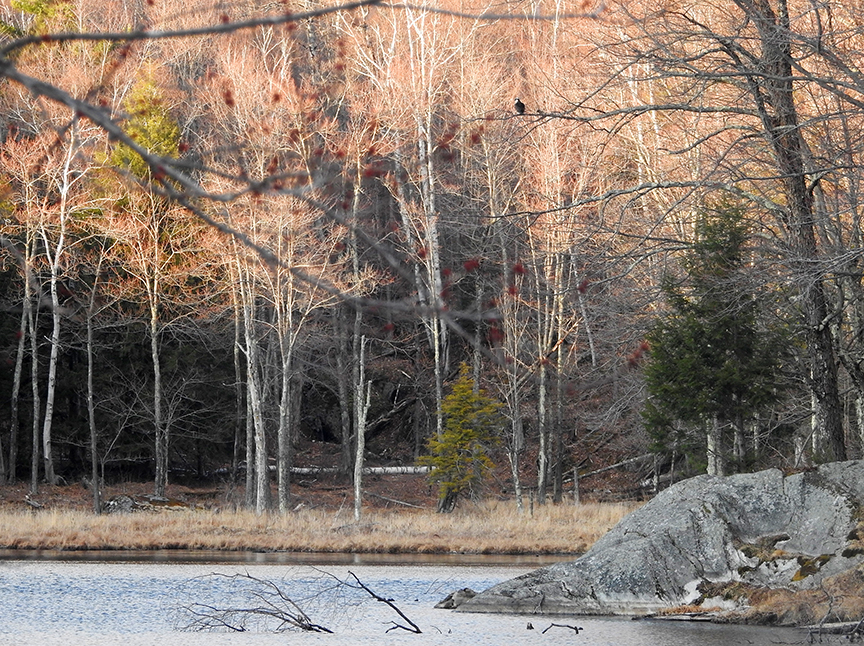
After a long day outside clearing tops and hauling some logs I dropped this winter (or was it last?), Bonnie and I walked over to the pond around 6:30 pm. Bonnie saw it. An Osprey was perched above the ledges on the east shore. I've heard them from time to time, but never seen one on the pond itself (very common elsewhere such as Mississquoi).
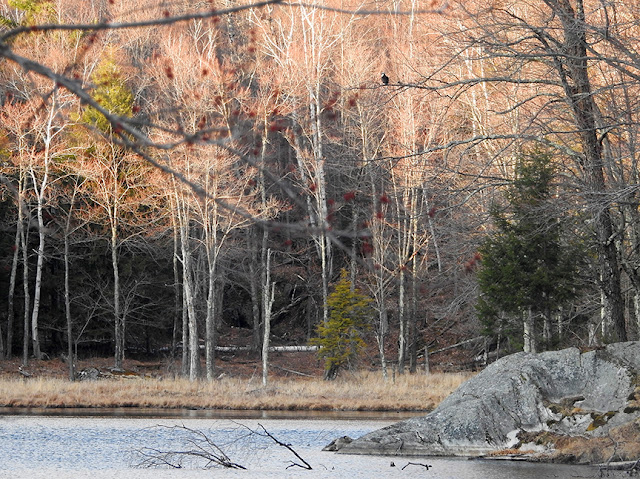 Couldn't get a really good shot, but took these just for the record.
 Then after Bonnie and the dogs went back to the house, I sat down for a bit. While scanning out over the pond to the north, I saw a dark shape porpoise near the main lodge. Didn't look right for a beaver, so I scanned with the binocs. The otters were back. They started periscoping, looking at something on the west shore. Turned out to be our neighbors going down to do some fishing.
The morning before, we had stayed out at the pond overnight (our part). The Common Mergansers were going at it pretty noisily sometime before 5 am: one hen, her main paramour and three other males all trying to join in. They settled down by the time it was light enough for shooting, but we were well positioned for some good shots and video.

Courting still seems to be in full swing and it is hard to figure who, if any will nest. The geese are still here: sometimes just two, but Monday there were 12. Three Mallard drakes were here this week and a pair of Hooded Mergansers were on the Upper Pond. I think the Woodies have nested, but can't be sure. Don't see them regularly, but they have been around now and then for over a month. I saw one flush out of a tree not far from the pond margin and will keep an eye peeled.

After a long day outside clearing tops and hauling some logs I dropped this winter (or was it last?), Bonnie and I walked over to the pond around 6:30 pm. Bonnie saw it. An Osprey was perched above the ledges on the east shore. I've heard them from time to time, but never seen one on the pond itself (very common elsewhere such as Mississquoi).

The morning before, we had stayed out at the pond overnight (our part). The Common Mergansers were going at it pretty noisily sometime before 5 am: one hen, her main paramour and three other males all trying to join in. They settled down by the time it was light enough for shooting, but we were well positioned for some good shots and video.

Courting still seems to be in full swing and it is hard to figure who, if any will nest. The geese are still here: sometimes just two, but Monday there were 12. Three Mallard drakes were here this week and a pair of Hooded Mergansers were on the Upper Pond. I think the Woodies have nested, but can't be sure. Don't see them regularly, but they have been around now and then for over a month. I saw one flush out of a tree not far from the pond margin and will keep an eye peeled.

Wednesday, April 13, 2016
Flying Fish and (returning) Fleeing Beavers (changed during writing)

Ever since I'd seen the one beaver on Preston Pond as the ice opened, I've been trying to determine if it was the only one left (for anyone who missed it: in February, for the first time since beavers were trapped out in the 18th Century and subsequently returned in 1946, the Bolton Select Board approved trapping in Preston Pond - two dead - the Upper Pond - one or two dead - and along the hiking trails - not done as far as I know). That effort continued of course after videoing it farting as it climbed the shore with a load of greenery (previous post if you are juvenile enough to want to see it: I filmed it and posted it, so join the club:-). Around April 1st, it dawned on me that far from seeing a second beaver, I had not seen the one in several days. That was unusual. I checked the satellite ponds like the Pudding Stone Pond here.

I didn't find any sign of beavers, but I did see this Flying Fish leaping out of the slushy ice during a snow squall. These ponds have all been abandoned for a couple years at least, but I had seen some possible sign of a visiting beaver a couple weeks before (though it could have been any similarly sized animal swimming or walking through the thin ice) and hoped that our survivor had gone exploring. No such luck.

I don't know if it is in common usage with anyone else, but the name "Pudding Stone" comes from this enormous boulder - possibly a "local" erratic that overlooks the pond and is studded with magnetite crystals. My grandfather dubbed it the Pudding Stone before I was born, though as my wife Bonnie points out, pudding is supposed to be smooth. I'd never thought of that before. Possibly my great grandmother wasn't a great cook - or there is some Irish pudding with dark chunks in it.

I had checked the pond on the LT a few weeks ago and it has been abandoned for a couple years. None of the satellite ponds associated with Preston Pond, apart from the Upper Pond on the VAST trail have any beavers in them.

April has had as much snow as most of the winter (which isn't saying much), and it had gotten a bit cold after it had been missing for a week or so. I have been hoping that the beaver had holed up somewhere during the chill snap. Beautiful nonetheless.

With wondrous marvels almost anywhere.

And even delicacies to eat if you work up an appetite (interesting to speculate on why this was left opened, but uneaten: could raccoons really be that fussy?

However, despite 2-3 circuits of the ponds every day and 24/7 coverage of the lodge with a trail cam, no beaver. Plenty of ducks though.

And geese. While there are still some pairing competitions being settled, between the two ponds I've seen male/female pairs of Hooded Merganser, Common Merganser, Wood Ducks, Mallards, and Canada Geese. The Hoodies may have moved on, but all of the rest look to be setting up house. I'm not getting much for photos since I'm leaving them be up at the north end. The geese, however, are quite tolerant and actually followed us along shore and hung around nearby while we had a get together with almost a dozen people on Sunday. But no beavers. For 18 days.
Right up to this afternoon: nada. The trail cam at the lodge only had the test shot on it.
Then when Bonnie and I went out at 5:30 this evening I saw a third merganser up at the north end. Glassing it (a second male has shown up) I noticed a fourth duck: an oddly brown one. It is a quarter mile away and at a low angle and the hand held binocs are not that steady, but there was something oddly familiar about that "duck." I was 99% sure it was a beaver. Nainette and I went back out after dinner and did a fast circuit. Confirmed: along with the Common Mergs, Canadas, and a Great Blue Heron (in the area of the goose nest), up at the north end I again spotted the "brown duck" from high up on the west shore trail. It worked along in close to the shore swimming with a big stick. A lone beaver (at least) has returned to the pond. By then it was too dark for good shots.
I went to the Upper Pond where I'd seen positive beaver sign for quite a while to try to confirm it was definitely at least a second beaver. While I had seen sign (and possibly heard a slap a week ago), I had not seen a beaver there either, though I was pretty sure they were around. Sure enough - one beaver was on patrol on the Upper Pond too. I went back around to reload the trail cam and the Preston Pond beaver cruised offshore watching. So, whether it had gone to bed to wait out the cold, gone on a walkabout and returned, or this is an entirely different beaver, we at least have one back. The dam is still gushing water, and it is a lot to do for one beaver, but it was a joy to see one back where they belong. Will keep an eye out for more and get some close-ups from which I can probably determine if it is the same one that was here almost three weeks ago.
with a load of greenery
Subscribe to:
Posts (Atom)